 Save
Save I discovered this platter completely by accident at a rooftop summer party where the host had arranged vegetables and fruits on a black board, and something about the contrast made everything look alive under the evening lights. The idea stuck with me for weeks—how food could be arranged like art, and how the flavors would shift from tangy pickles to sweet fruit in a single bite. When I finally recreated it at home, I realized the real magic wasn't just in looking beautiful; it was in building layers of flavor and texture that kept people reaching back for more. Now whenever I need something that feels special but doesn't require hours in the kitchen, this is what I make.
The first time I made this for friends, someone asked if I'd hired a caterer, and I couldn't stop laughing—it was just pickles and eggs arranged thoughtfully on a board I found at a thrift store. That moment taught me that presentation and flavor working together create something that feels effortless and generous at once. Now my kitchen always has a black board ready because people genuinely light up when this appears.
Ingredients
- Mini cucumbers: Their thin skins turn translucent when pickled, and they stay crisp if you slice them thin and don't over-pickle.
- Rainbow carrots: The bias cut makes them catch light and cook more evenly; regular carrots work but lose some visual magic.
- Radishes: They keep their peppery snap in the brine if you slice them just before pickling, and they bleed that beautiful pink color slowly.
- Red onion: Thin slices mellow into sweetness and turn a deeper magenta—save the thinnest rings for the top of the board.
- White vinegar and spices: The mustard seeds and peppercorns add texture and flavor complexity that plain vinegar never could.
- Eggs: Large eggs give you a bigger canvas for the beet color, and 8-9 minutes gets you a jammy yolk if you like that.
- Cooked beet: It should be soft enough to slice easily; the sliced version stains more evenly than grated, and you'll know it's working when your jar turns from clear to ruby.
- Fresh fruits: Choose whatever's in season—mango and dragon fruit are dramatic, but strawberries and pineapple work just as well and cost less.
- Microgreens and flaky salt: These are the final notes that say someone actually cared; they catch the light and add a real finishing touch.
Tired of Takeout? 🥡
Get 10 meals you can make faster than delivery arrives. Seriously.
One email. No spam. Unsubscribe anytime.
Instructions
- Build your pickling brine:
- Combine the vinegar, water, sugar, salt, mustard seeds, and peppercorns in a saucepan and bring to a gentle simmer. You'll know it's ready when the sugar dissolves completely and the mustard seeds start to smell warm and slightly sharp.
- Quick-pickle the vegetables:
- Slice everything thin and even—this matters because uniform pieces will marinate at the same speed. Pour the hot brine over them in a heatproof container, let it cool, then refrigerate for at least 2 hours.
- Hard-boil and ice-shock the eggs:
- Cover eggs with cold water, bring to a rolling boil, then let them cook for 8-9 minutes depending on how cooked you like them. Transfer immediately to ice water; the shock stops the cooking and makes peeling easier.
- Create the beet dye:
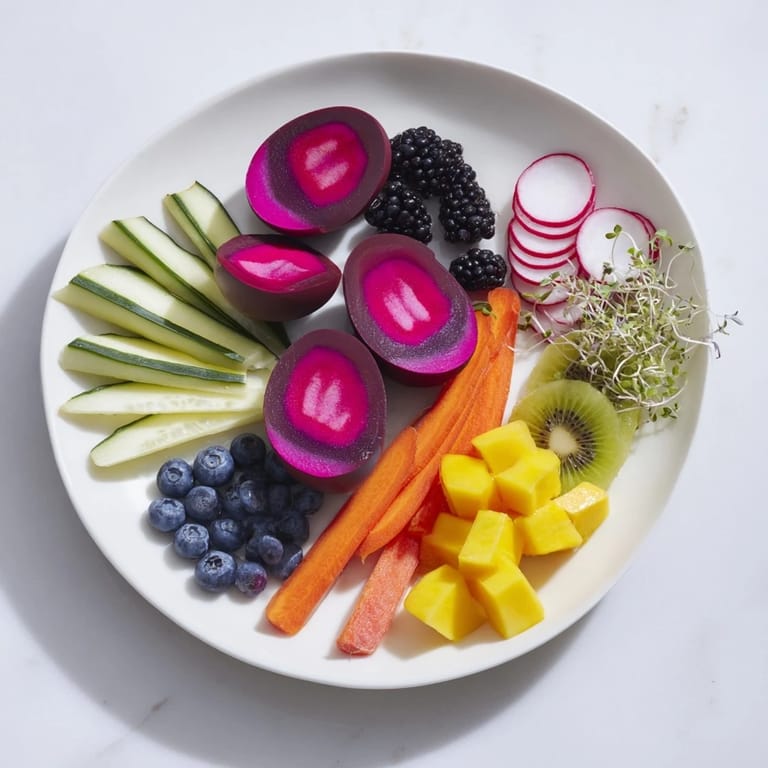
- In a clean jar, layer the sliced beet with vinegar, water, sugar, and salt—then add your peeled eggs. This is where patience pays off; after 2 hours the eggs turn a soft pink, and by the next day they're a deep magenta with faint beet-juice lines running through the white.
- Arrange with intention:
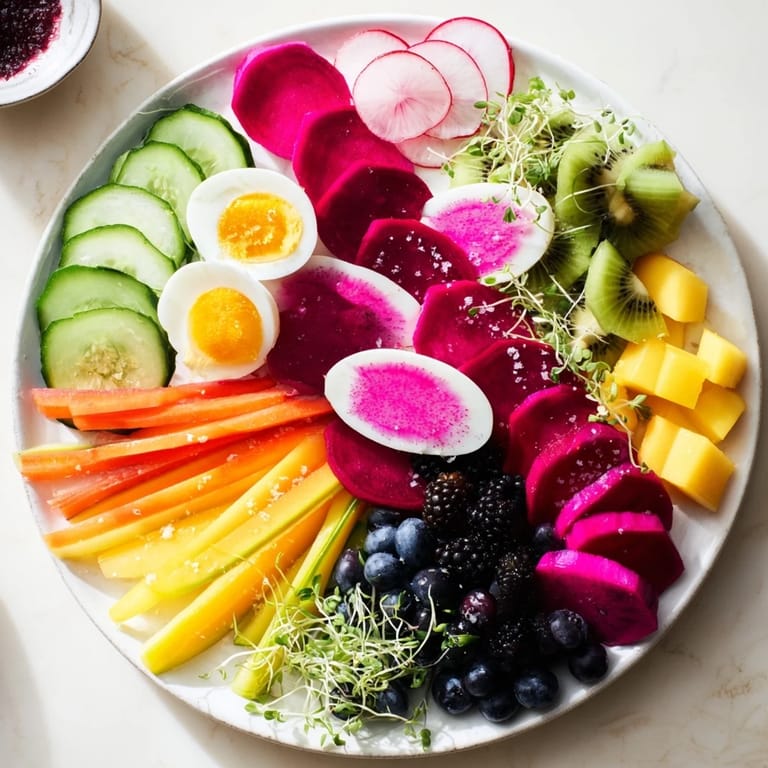
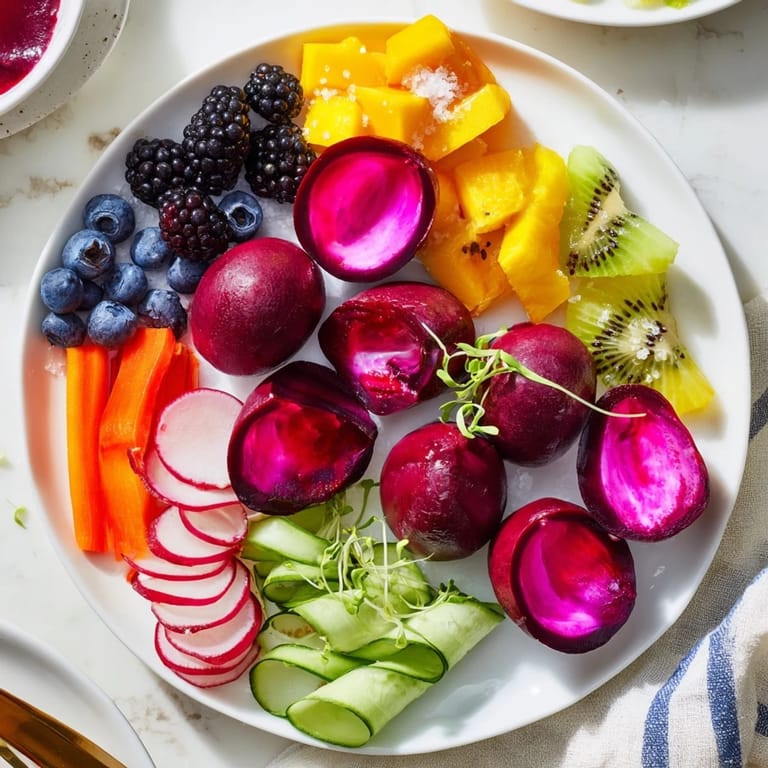
- On your black board, place pickled vegetables in clusters, halve or slice the beet eggs to show their color, and scatter the fresh fruits between them. Leave some breathing room—crowding it makes it look messy instead of intentional.
- Finish and serve:
- Just before serving, scatter microgreens or edible flowers in the gaps and finish with a light sprinkle of flaky sea salt. Serve chilled so everything stays crisp and the colors stay vibrant.
 Save
Save There's a specific moment when I pull the beet-dyed eggs from the fridge and see how the color has deepened overnight—it never stops feeling like a small kitchen miracle. It's the moment I remember why I love feeding people things that taste as good as they look.
The Art of Color on a Board
The black board isn't just for looks; it actually makes every color pop with an intensity that white dishes can't match. When I arrange this, I think about balance—keeping warm yellows and oranges on one side, letting the deep reds and magentas have their own space, and using the bright greens and pinks of fruit to bridge between them. The board becomes like a painting, and somehow that makes people take fewer things but enjoy them more fully.
Timing and Prep Strategy
The secret to making this feel effortless is doing almost everything the day before—both the pickles and the beet eggs actually taste better with overnight marinating anyway. On the day of, you really only need to hard-boil eggs and slice fresh fruit, which takes maybe 15 minutes. This is why I keep this in my back pocket for entertaining; most of the work happens when I have time to breathe, not when guests are walking through the door.
Variations That Still Shine
Once you understand how the basic formula works, you can swap almost anything—use purple cabbage instead of radishes, add pickled mushrooms, switch the fruit to whatever your market has. The pickling brine stays the same, the egg-dyeing method stays the same, and suddenly you have a completely different-looking board that still feels special. I've made versions for winter (with roasted beets and persimmons) and summer (with berries and stone fruits), and each one feels like its own small celebration.
- Try adding a thin drizzle of sesame oil or walnut oil to the pickles for unexpected depth.
- Pickled vegetables keep for up to a week in the fridge, so you can make them ahead even further.
- If you want to go vegan, double the pickled vegetables and add marinated tofu cubes for protein.
 Save
Save This platter taught me that the most satisfying food moments aren't always about complicated techniques—sometimes they're about arranging beautiful ingredients in a way that makes people pause before they eat. Every time I make it, I'm reminded that there's real generosity in putting thought into how something looks.
Recipe FAQ
- → How long should the pickled vegetables marinate?
For best flavor, refrigerate the pickled vegetables for at least 2 hours, preferably overnight.
- → What is the purpose of beet-dying the eggs?
Beet-dying adds a natural vibrant color to the eggs and subtly infuses them with earthy notes.
- → Can the pickling liquid be customized?
Yes, you can use natural coloring agents like turmeric or purple cabbage for varied brine hues.
- → What garnish complements this platter?
Microgreens or edible flowers paired with flaky sea salt enhance both flavor and presentation.
- → Is this suitable for a gluten-free diet?
Yes, all ingredients used are gluten-free, but always check packaged items like vinegar for hidden allergens.